
The King Faisal Center for Research and Islamic Studies (KFCRIS), through its UNESCO Chair in Translating Cultures and with the support of the Literature, Publishing and Translation Commission, is pleased to invite applications for the Early Scholars Publication Grants. These grants support the publication of outstanding PhD dissertations that critically examine contemporary debates related to the UNESCO Chair’s two themes for this year and adopt a global perspective that moves beyond Eurocentrism. Early Scholars Publication Grants will be awarded for this year's two themes:
The UNESCO Chair in Translating Cultures invites PhD dissertations that explore modern Arab thought as a field of philosophical production and conceptual experimentation, rather than as a derivative cultural response or a regional supplement to European philosophy. Building on recent contributions in the field, this theme for Early Scholar Publication Grants aligns with the growing scholarship that integrates Arab intellectual work into the core of philosophical discourse, highlighting its conceptual depth and internal diversity. Specifically, recent interventions demonstrate that twentieth century Arab thinkers did not merely respond to modernity but actively contributed to it, producing original reflections on reason, critique, ethics, language, and the formation of modern thought.
Such reflections have shown that the twentieth and early twenty-first centuries constituted a decisive period for Arab thinkers, who reformulated foundational philosophical problems amidst decolonialization and global epistemic shifts. Thinkers such as Mohammed Abed al-Jabri and Mohammed Arkoun foregrounded questions of reason, interrogating inherited structures to reveal the historical conditions of rationality. Simultaneously, thinkers like Zaki Naguib Mahmoud and Abdallah Laroui engaged with scientific rationalism and ethical responsibility, advancing competing yet intersecting analyses of modernity. Moving beyond the framing of these works as ‘belated’ receptions of European thought, contemporary scholarship has emphasized how Arab thinkers generated original critiques through selective appropriation, conceptual reworking, and methodological deconstruction.
Dissertations should engage these debates as internally contested fields of inquiry—exploring critiques of reason, re-evaluations of heritage, or emerging reflections on subjectivity, gender, and futurity. Applicants must demonstrate close engagement with Arabic-language sources, showing how philosophical concepts are transformed within the language itself, whether in philosophy, literary theory, or adjacent critical traditions. In this framework, translation occupies a central analytical category. Beyond the translatability of concepts such as ʿaql, turāth, and ḥadātha, we welcome projects that analyze translation as a formative condition of modern Arab philosophy—including studies of conceptual equivalence, untranslatability, and the circulation of ideas across linguistic and regional boundaries.
The Chair prioritizes works that move beyond Eurocentric trajectories of reception, such as intra-Arab philosophical debates, South–South exchanges, or multilingual constellations where Arabic functions as a site of critique and innovation. Projects may treat Arab thought as theory-generating rather than illustrative. By supporting such scholarship, this Grant seeks to re-map global intellectual history, not simply by expanding the canon, but by interrogating the criteria through which philosophy and theory are recognized.
Core Research Questions
Applicants are asked to indicate which of the following questions their dissertation engages, and where this engagement appears (e.g., “Chapter 2 addresses Question 3; Chapter 5 returns to Question 6”). Desertions must engage with at least one of the following questions.
- How do modern Arab thinkers working in Arabic conceptualize reason (ʿaql), critique (naqd), and epistemic authority in dialogue with, yet not reducible to, European philosophical traditions, and what conceptual shifts emerge through acts of translation and negotiation?
- In what ways does translation function as a generative practice in modern Arab thought, particularly concepts are reformulated or rendered unstable in the absence of stable conceptual equivalences?
- To what extent do choices of linguistic form, rhetorical strategy, or genre (essay, manifesto, treatise, critical prose) shape the articulation and global standing of Arab philosophical positions?
- In what ways do intra-Arab intellectual exchanges across regions and institutions complicate Eurocentric narratives, and can translation be used to trace these internal circuits of debate and influence?
- How do Arab thinkers theorize the ethical subject, agency, and responsibility in relation to colonial rupture, political authority, or historical discontinuity?
- In what ways do modern Arab philosophical texts interrogate the definitions of “philosophy” itself, and how does translation mediate their integration into global intellectual history?
- How do institutional pathways of circulation for translated Arabic texts shape contemporary canon formation, and what kinds of exclusions or reconfigurations emerge through these processes?
The UNESCO Chair in Translating Cultures invites Early Scholars Publication Grants’ submissions that pay particular attention to how young people negotiate linguistic, cultural, and international boundaries. While the categorization of “youth” remains fluid and contested, the necessity for scholarly exploration of youth culture has never been more evident. Contemporary youth are not merely recipients of culture but active agents in shaping its evolution. As Mary Bucholtz observes, language “constitutes a flexible and omnipresent” resource for cultural innovation, and, in the contemporary era, youth are at the forefront of this change. Living in an era defined by rapid digital transmission, global media circulation, and intensified transnational contact, young people must continually navigate and mediate between local traditions and international cultural forces.
We welcome research that investigates the emergence of hybrid linguistic forms—including the interplay between Modern Standard Arabic, regional dialects, Arabizi, and global loanwords—as acts of translating cultures. This use of hybrid language can carve out autonomous “third spaces,” that resist rigid distinctions between “youth” and “adult” speech and between “local” and “hegemonic” language and culture. Submissions may also address concerns regarding language loss or translation challenges. As Kaja Makowska argues, code-switching constitutes a central challenge of translation, and Julieta Alós notes that evolving youth vernaculars demand new translation strategies. Other studies such as Mustafa Taha’s highlight how hybrid linguistic forms like Arabizi are often perceived as threats to language and identity. We encourage projects that examine how youth use such hybrid language to negotiate place, individuality, and belonging, as well as those that investigate the nature of such linguistic forms as either sources of cultural anxiety or creative adaptations.
The evolution of language reveals how identity is negotiated; the creative appropriation of cultural artifacts offers a tangible map of that process. Bridging the gap between linguistic performance and the broader cultural landscape, we also invite submissions that examine the intersection between global forms and local contexts. This area of inquiry seeks to understand how young people translate transnational symbols—such as fashion, memes, musical genres, or online vernaculars—into locally meaningful forms. Referencing Mary Bucholtz’s work on transnational youth styles, we encourage studies that move beyond linear models of cultural influence to analyze how borrowing operates multidirectionally.
A significant, yet often overlooked, site for local adaptation and translating cultures exists within contemporary literature. Young Adult literature has grown dramatically since the 2000s, expanding the perspectives accessible to global youth. The translation of these texts has not seen sustained scholarly attention. We encourage research that investigates how global YA themes are localized and reimagined for regional markets and how these translated narratives influence the development of youth identity, peer-group formation, and sociolinguistic norms. Projects may examine the challenges of translating code-switching language and youth-specific registers, as well as the broader cultural implications of adapting global narratives to local expectations.
Relatedly, the grant seeks proposals that explore the translation and social impact of illustrated and idiomatic narratives, such as Japanese manga, light novels, and related visual genres, within local youth cultures. Drawing on studies such as the manga project in Saudi Arabia, which includes two magazines: “Manga Al-Arabia” and “Manga Al-Arabia for Kids,” and Urwa Tariq and Sarah Willard’s work on Emirati engagement with Japanese pop culture, projects may examine how exposure to transnational media can produce patterns of meaning that overlap with existing cultural frameworks rather than displace them. In such contexts, translation can be understood as a cultural process that encompasses aesthetic norms, reading practices, and character archetypes—not simply linguistic transfer alone.
We seek to approach youth culture from a global-Arab cultural intersection, adopting a viewpoint that does not reduce youth to a transitional phase toward adulthood. Rather, we recognize young people as active participants who shape and redefine culture, language, and media within the Arab world and beyond. By synthesizing these inquiries into Arab cultural contexts, transnational symbolic exchanges, and the translation of Young Adult literature, successful proposals will examine how youth translate cultural expressions, navigate linguistic and digital infrastructures, and produce new meanings both within and across national boundaries. Selected submissions will be published after review and revision, offering new insights into the evolving relationship between translation, identity, and youth social practice in the contemporary world.
Core Research Questions
Applicants are requested to specify which of the following questions their dissertation addresses and to indicate where this engagement occurs (e.g., “Chapter 2 addresses Question 3; Chapter 5 returns to Question 4”). Each dissertation must engage with at least one of the following thematic inquiries.
- How do practices such as code-switching and code-meshing between Modern Standard Arabic, colloquial dialects, Arabizi, and global languages serve as mediums through which youth perform identity, negotiate authority, and construct autonomous “third spaces” within or beyond existing cultural frameworks?
- To what extent do translation strategies regarding Young Adult literature, manga, light novels, and other similar forms negotiate youth-specific registers, code-switching, and aesthetic norms? What role do these translated texts play in shaping identity formation, consumption practices, and peer-group culture?
- What are the mechanisms through which social media platforms and a high degree of digital interconnectedness drive the transmission and transformation of youth linguistic practices, and how might these shifts challenge conventional notions of linguistic continuity and standardization?
- Through what processes are transnational symbols such as fashion styles, memes, musical genres, or narrative tropes reinterpreted within specific local contexts? By what means does this reimagination shape youth belonging, regional/national identity, and cultural affiliation, and how does it challenge standard linear models of cultural influence?
- In what ways do aesthetic norms, reading practices, and character archetypes undergo cultural translation? Furthermore, what theoretical framework might allow researchers to account for these non-verbal dimensions of youth literature in translation studies?
- Have completed a PhD in a relevant field, such as Arabic language and culture, translation studies, comparative literature, philosophy, anthropology, folklore, Middle Eastern studies, or cultural sociology.
- Have written a dissertation in English related to the Chair’s themes for 2026: Modern Arab Thought in Translation or Translating Youth Culture/s
- Hold a PhD from a research institution worldwide awarded between 2020 and 2025.
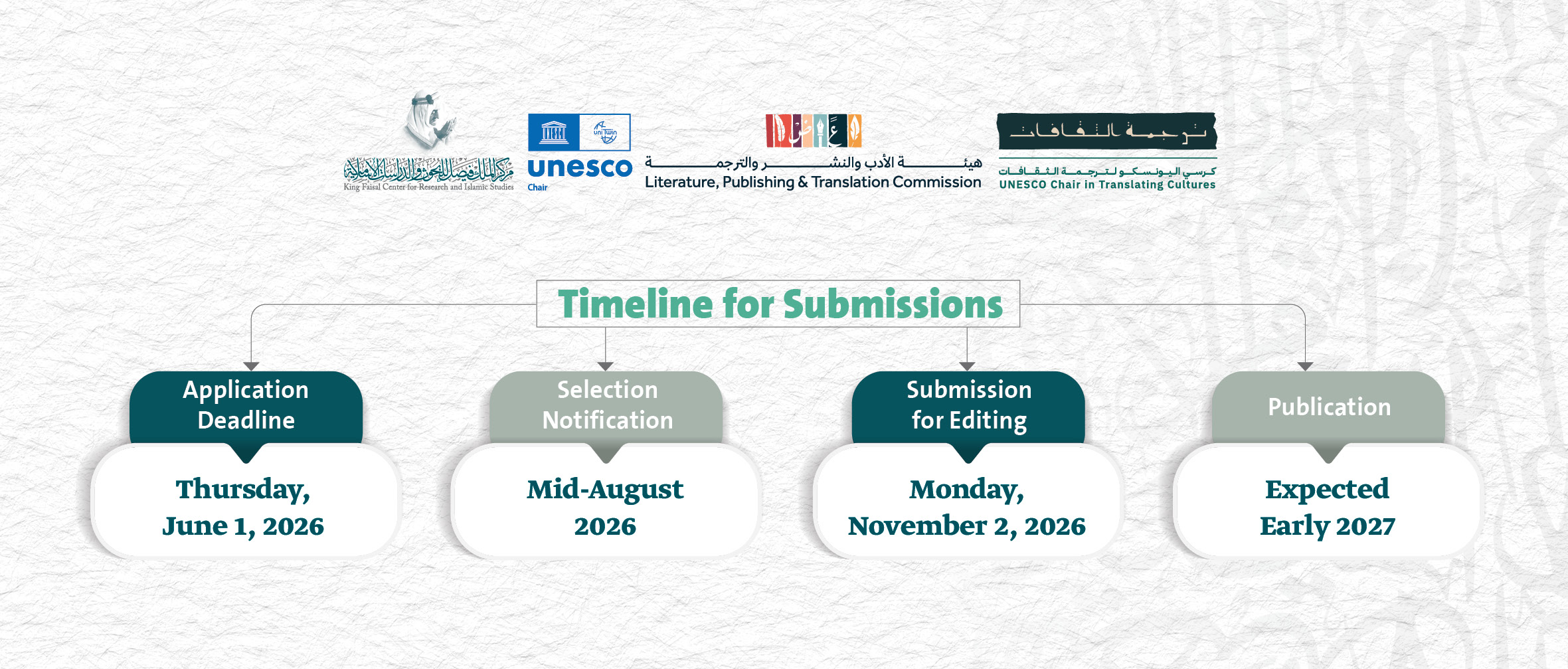
Applications for doctoral grants are due Thursday, June 1, 2026, at 11:59 PM Riyadh time (GMT+3). All application materials should be submitted through email to contact TranslatingCultures@kfcris.com.
Submissions must be in English and should include the following materials:
Email Subject Line: Early Scholars Publication Grants – [Full Name]
Required Information (Email Body):
- Full Name
- Nationality
- Email Address
- Current Academic Level
- Name of University / Educational Institution
- Field of Study
Required Documents (Attachments):
- Abstract and a complete chapter that includes the main argument of the thesis under consideration.
- Applicant’s CV.
- Statement of purpose describing your research and the reasons why your dissertation is appropriate for publication, as well as how your dissertation topic aligns with the themes and goals of the UNESCO Chair (2–3 double-spaced pages).
- Two letters of recommendation
Applications will be reviewed using a “double-blind” process and assessed based on eligibility requirements, publication standards, and academic merit.